By the Rev. Dr. Carter Heyward
- Episcopal Theological School in Cambridge (founded 1867) and Philadelphia Divinity School (founded 1857) merged to become Episcopal Divinity School (EDS) in 1974. Both institutions were renowned for their progressive teaching approaches and innovative pedagogy. The two deans of EDS at the time of the merger – the Rev. Dr. Harvey H. Guthrie, Jr. from ETS and the Rev. Edward G. Harris from PDS – were serving as co-deans of the newly formed EDS.
In a Times article published shortly after the Philadelphia Eleven were ordained on July 29, 1974, Harris was named an important influence in the groundswell of pressure leading to the ordination of women: -
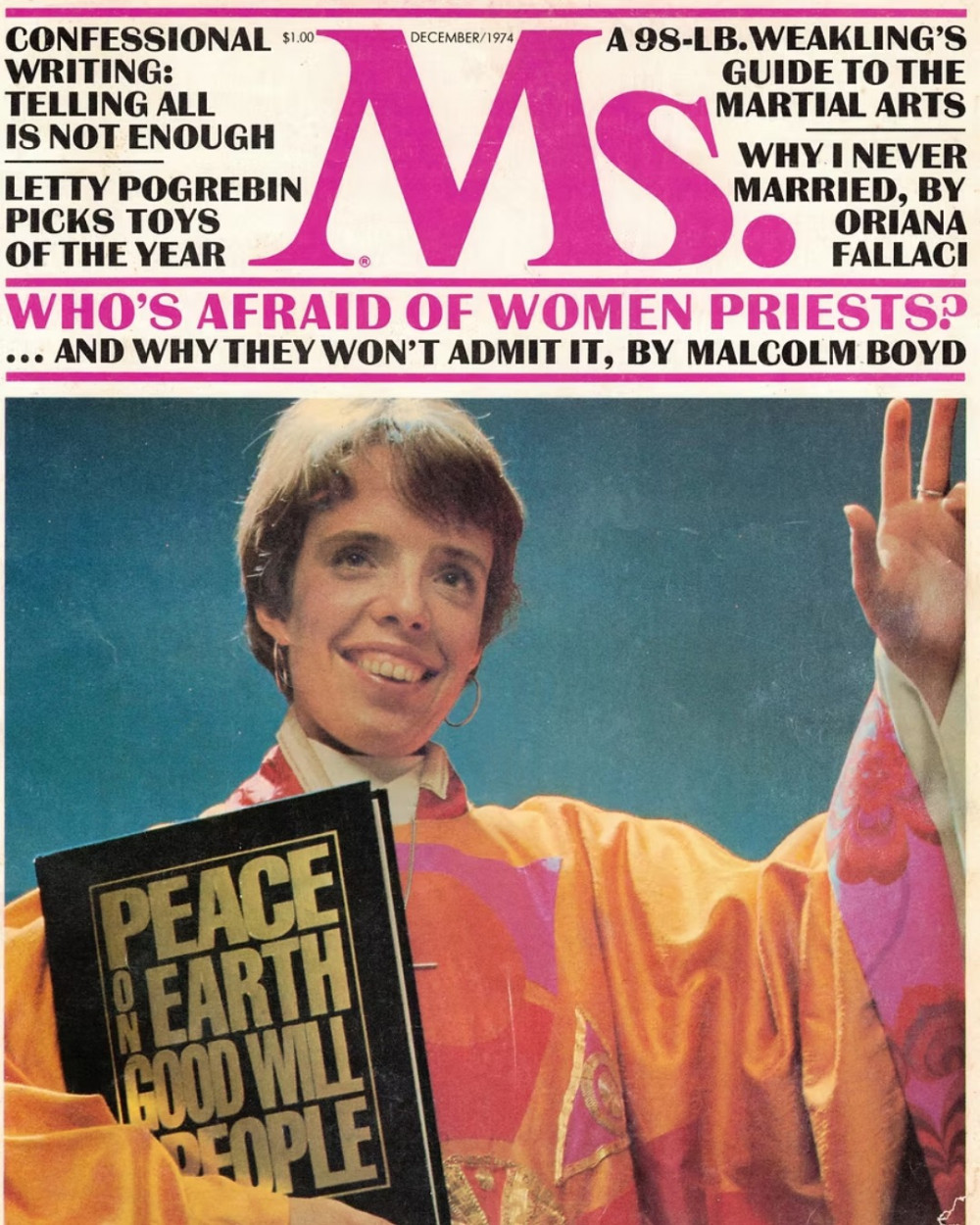
MS Magazine cover, Dec 1974; Photo by Lillian Bassman
Just who began the 1974 Philadelphia revolution is unclear. One important influence was the Rev. Edward G. Harris, co-dean of the Episcopal Theological School in Cambridge, Mass., who issued an impassioned call in June for the immediate ordination of women.
Following the Philadelphia Eleven ordination of 1974, Deans Harris and Guthrie announced that EDS would hire “an ordained woman” as soon as possible (quotations applied because the ordinations were still considered irregular). Immediately, EDS contacted the Philadelphia Eleven to see if any of us were both qualified and interested in a position with EDS. In response, three of the Philadelphia Eleven conspired to ask that the seminary hire two, not one, of us—namely, Sue Hiatt in Pastoral Theology and me, Carter Haymard, in Theology. Alison Cheek had been the other contender in Pastoral Theology, but she decided that she did not want to move away from northern Virginia, where her husband worked. EDS agreed to hire Sue and me, both half-time, for three years. In my case, I agreed to finish my PhD in theology at Union Seminary as soon as possible, since a doctorate was desirable in the field of theology.
Sue arrived to teach at EDS in the spring of 1975 and I arrived the following fall. On a faculty of 28, there was one other woman at the time—Sr. Bessie Chambers, R.S.C.J., a bright and caring woman teaching Pastoral Theology. Sr. Chambers was a Roman Catholic nun in the Society of the Sacred Heart.
Sue and I began a 25+ year collaboration as feminist theologians and teachers who were committed to recruiting women students, helping women negotiate the ordination process (hugely challenging for women at that time in most dioceses, where women's ordination was still a scary notion for most Episcopalians), counseling women who were seeking ordination and those who just wanted a good theological education, and, of course, teaching courses. Sue specialized in courses on preaching, pastoral care, and community organizing. I taught courses in Anglican theology, modern and contemporary theologies of Black and Latin American Liberation theology, feminist theologies, courses in Christology, Elie Wiesel, and later a theology of sexuality. Sue and I also worked on making the weekly liturgies more inclusive of feminine imagery and language (something that still, to this day, has not been taken seriously in The Episcopal Church by and large).
-
Sue and I joined our brother priests as celebrants of the weekly Eucharists in the St. John’s Chapel. Both of us, at first, were a bit shaken when certain male students would turn their backs on us whenever one of us was celebrant. We were also aware that several of our male faculty colleagues did not welcome us at the altar as priests and would make themselves scarce whenever our turns rolled around on the celebrant rota. This changed over time and, within about 10 years, nearly all of our faculty colleagues accepted us.
-
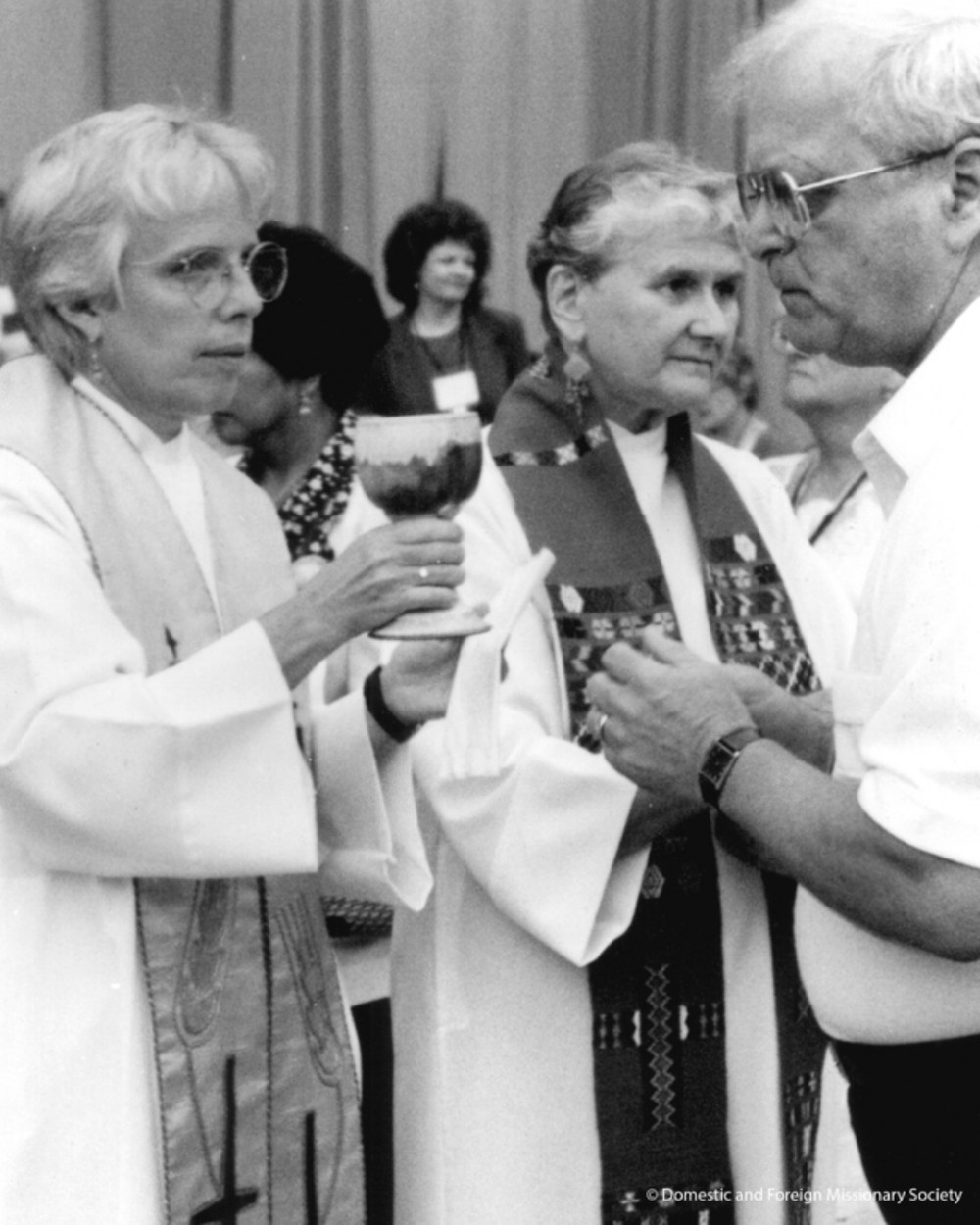
The Rev. Carter Heyward (left) and the Rev. Allison Cheek serve at a special convention Eucharist honoring the ministry of women, 1994.
At the beginning, there were many students who refused to take courses from either Sue or me. Sometimes, they had been instructed by their bishops to avoid us. Often, it was simply their own fears and uncertainty about what our "agenda" was. One of the sadder experiences both Sue and I had from time to time was interacting with women students who found us offensive and tried to avoid us. Sometimes, it was due to our “irregular” ordination. Sometimes, it was because I had come out as a lesbian. Often, we assumed, it was because we represented a possibility—strong, capable women priests—that these students both feared and yearned themselves to be.
By the mid-1980s and early 90s, we had helped bring other feminist women onto the faculty:
- Dr. Fredrica Harris Thompsett, Episcopal Church historian;
- The Rev. Dr. Katie Geneva Cannon, widely regarded as a founder of the Womanist movement and a formidable liberation theologian and Christian ethicist
- Dr. Elisabeth Schüssler Fiorenza, Roman Catholic theologian and pioneer in biblical interpretation and feminist theology
- Dr. Kwok Pui-lan, EDS’ current Distinguished Scholar with an expertise in Asian feminist theology and postcolonial theology
- Dr. Angela Bauer-Levesque, professor of Bible, Culture, and Interpretation
- Dr. Gale Yee, Hebrew Bible scholar with emphases on postcolonial, ideological, and cultural criticism
- The Rev. Dr. Joan Martin, scholar of Christian Social Ethics
- The Rev. Dr. Renee Hill, scholar of religion and social change with emphases on religious pluralism, liberation theologies, and feminist studies
- Karen Montagno, former Dean of Community Spiritual Formation, co-edited Injustice and the Care of Souls with Sheryl A. Kujawa-Holbrook, EdD, PhD, FRHistS, former academic dean and professor of feminist pastoral theology and church history at EDS
- The Rev. Dr. Alison Cheek, the first Episcopal woman priest to publicly celebrate the Eucharist and former director of Studies in Feminist Liberation Theology at EDS
- Dr. Demaris Wehr, Quaker Jungian psychotherapist and professor of religion and psychology
- Peg Huff, pastoral psychologist
and many other adjuncts and field educators.
One of our primary, shared commitments as feminist and womanist women was to anti-racism—to make sure that race and gender were held together in all studies of justice matters. Together, the women faculty initiated a program that would become widely acclaimed in the United States and elsewhere as unique and remarkable: a Doctor of Ministry program in Feminist Liberation Theologies. Its first coordinator was Alison Cheek of the Philadelphia Eleven.
Slowly, over decades, from the 70s to the 00s, The Episcopal Church increasingly appreciated EDS's contributions not only to feminist theologies but to other theologies of liberation such as the Asian and post-colonial theologies being generated by scholars such as EDS's own Kwok Pui-lan, and always to the anti-racist core commitment of all good theology.
Sue Hiatt and I used to say to each other in the 1970s, 80s, and 90s—
"If EDS didn't exist, The Episcopal Church would have to invent it."
In other words, regardless of The Episcopal Church's fears about what was happening at EDS—specifically its fear of the strong feminist, anti-racist, and LGBTQ+ advocacy at the heart of its mission—the most astute leaders of the church knew well that what was happening at EDS was exactly what The Episcopal Church needed, and will always need, to weave into the core of its being a Body of Christ.
This article was written by the Rev. Dr. Carter Heyward - an American feminist theologian. In 1974, she was one of the Philadelphia Eleven, eleven women whose ordinations eventually paved the way for the recognition of women as priests in the Episcopal Church in 1976. In 1975, she began working at Episcopal Divinity School while it was still inn Cambridge, Massachusetts. As a professor, Heyward’s primary teaching concentrated on 19th century Anglican theology, feminist liberation theology and theology of sexuality. She transformed consciousness, proclaimed the possibilities for women to be priests, for lesbians to be theological, and made way for new approaches to connecting the divine to the erotic, justice, activism.